
New York E-Bike Laws in 2026: What Riders Need to Know
By Daniel Flanzig, Esq., Flanzig & Flanzig, LLP, and President of the New York Bicycling Coalition
New York allows e-bikes in three classes. Riders must be at least 16. No license or registration is needed. Class 3 e-bikes (up to 25 mph) are legal only in New York City, and in NYC every e-bike is capped at 15 mph. I've represented injured cyclists for nearly 30 years, and these are the rules I see matter most after a crash.
The short answer
- Three classes: Class 1 (pedal assist, 20 mph), Class 2 (throttle, 20 mph), Class 3 (throttle, 25 mph, NYC only).
- Minimum age: 16 for any class (VTL § 1242(2)).
- Helmets: required at every age on Class 3 (VTL § 1238(5-c)); under-14 rules apply as for any bicycle, Nassau County 18 y/o
- Roads: e-bikes may ride on roads posted 30 mph or less, unless local law says otherwise (VTL § 1242(8)). No sidewalks unless local law allows.
- NYC: 15 mph citywide cap since October 24, 2025.
- Local rules: cities, towns and villages can restrict or ban e-bikes. Long Island has its own two-step rule.
- If you're hurt: riding without a helmet, or being under 16, does not by itself reduce your injury claim (VTL §§ 1238(7), 1242(2)).
What counts as an e-bike in New York?
An e-bike is a "bicycle with electric assist" under VTL § 102-c. It must have working pedals, a motor under 750 watts, and meet federal bicycle safety standards. It must also fit one of three classes. Legal e-bikes have been allowed on New York roads since April 2020.
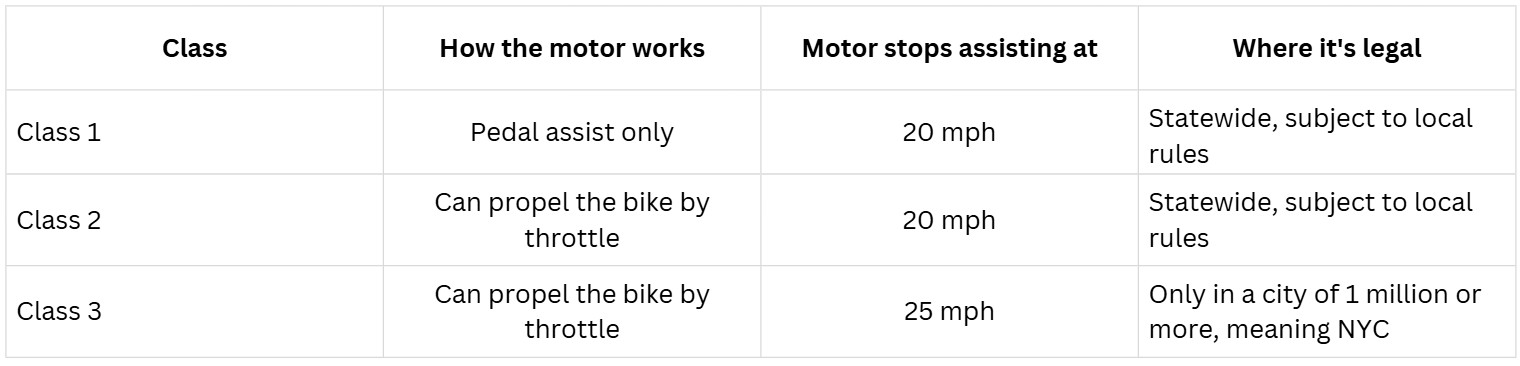
New York's Class 3 is different from most states. Elsewhere, Class 3 usually means pedal assist up to 28 mph. Here it means a throttle bike up to 25 mph, and riding one outside NYC is prohibited (VTL § 1242(10)).
Since June 1, 2022, every e-bike ridden on a public road must carry a manufacturer's label showing its class, top assisted speed and motor wattage (VTL § 1242(11)).
What isn't an e-bike: a machine that goes faster than 25 mph on its motor, or has a motor of 750 watts or more, is not a legal e-bike. It may be a moped that needs registration, insurance, and a license. That distinction matters a great deal in a crash case.
Age, helmet, license, and registration rules
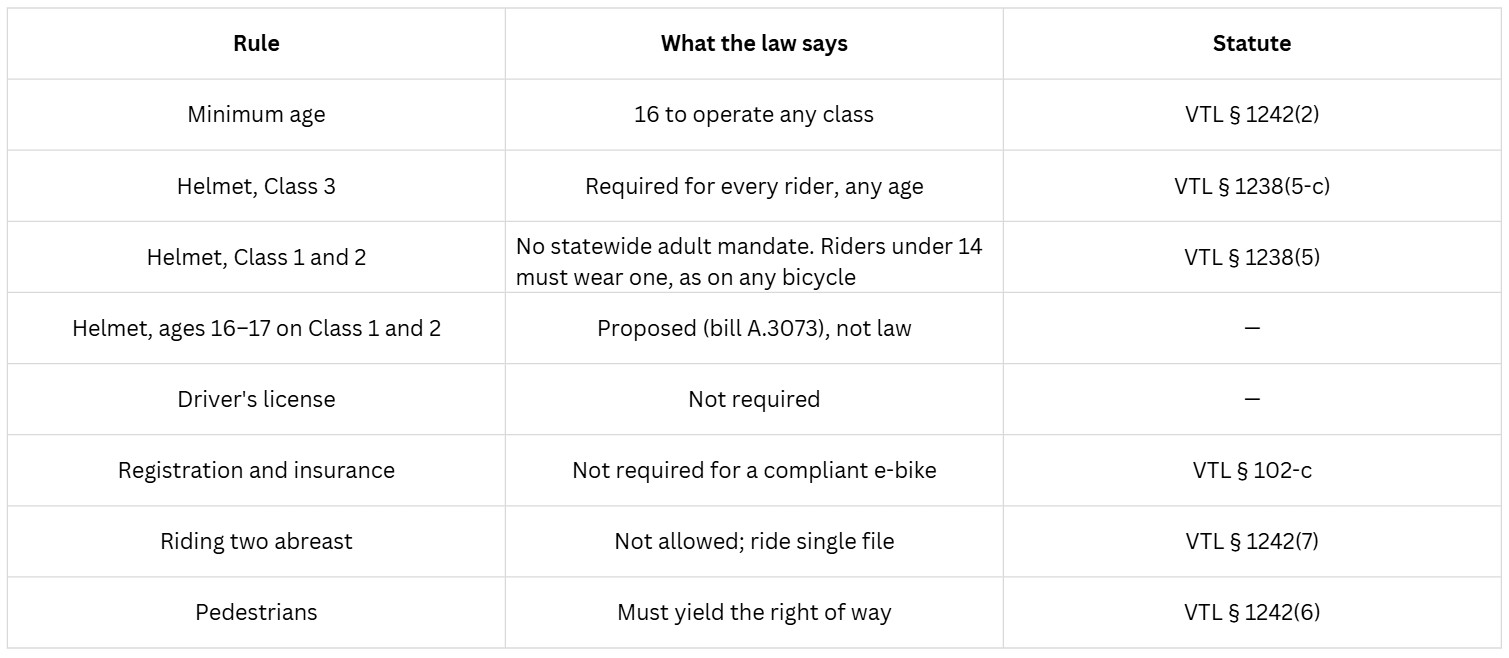
Most of these violations carry a civil fine of up to $50. A fine for riding Class 3 without a helmet is waived if you show the court you bought or rented one before your court date (VTL § 1238(6)(b)).
Local governments can add their own helmet rules, so check your town's code.
Where can you ride an e-bike in New York?
Statewide, an e-bike may ride on roads posted at 30 mph or less, on private roads open to cars, and in bike lanes, unless local law says otherwise (VTL § 1242(8)). Sidewalks are off limits unless a local law allows them (VTL § 1242(5)).
Parks and other public land are closed to e-bikes unless the managing agency designates them as open (VTL § 1242(4)). New York State Parks allows Class 1 and 2 on many paved trails and park roads. It bans Class 3 at its facilities and bans all e-bikes on its parkways.
New York City: since October 24, 2025, a DOT rule caps e-bikes, e-scooters and pedal-assist commercial bikes at 15 mph. It applies on streets, bike lanes, and paths in city parks, in all five boroughs. Class 3 bikes are legal in NYC, but they can't be ridden above 15 mph there.
State law sets the minimum. Local rules can be stricter, and Long Island has its own framework.
Long Island and other local restrictions
Any city, town, or village in New York can regulate when, where, and how e-bikes are ridden. It can set speed limits, require helmets, restrict e-bikes in certain areas, or ban them entirely, as long as it posts adequate signs at the boundaries (VTL § 1242(3)(a)).
Nassau and Suffolk have a special rule (VTL § 1242(3)(b)). A city, town, or village there can adopt speed, helmet, or reflective-clothing rules only after its county passes its own local law. That two-step requirement does not apply to an outright ban or to an area-specific prohibition. Westchester towns and villages follow a similar rule (VTL § 1242(3)(c)).
For riders on Long Island, the practical point is that the rules can change at a town or village line. Look for posted signs, and check the municipal code before riding somewhere new.
A pending challenge in Nassau County. Who gets to set these rules is now in court. Macchia v. County of Nassau (Sup. Ct. Nassau County, Index No. 611398/2026) is a combined Article 78 and declaratory judgment proceeding our law firm has filed challenging Nassau County's e-bike enforcement ban. The petition argues that state law, VTL §§ 102-c and 1242, preempts the county's approach because § 1242(3) gives the power to restrict or ban e-bikes to cities, towns, and villages. It also argues that the ban is arbitrary and capricious under CPLR 7803(3). The case is pending before Justice Erica L. Prager. Until the court rules, Nassau riders should follow posted signs and local enforcement.
Battery safety and what sellers must do
New York prohibits selling a lithium-ion battery for an e-bike unless an accredited lab has certified it to a recognized safety standard. Accepted standards include UL 2849, UL 2271, and EN 15194. Governor Hochul signed this law in July 2024. New York City has required UL-certified e-bikes and batteries since 2023.
In August 2026, the Attorney General issued a consumer alert. It warned that some businesses sell high-powered machines labeled as e-bikes that exceed New York's legal speed and power limits.
Before you buy:
- Look for the UL or EN certification mark on the bike and the battery.
- Confirm the manufacturer's class label shows Class 1, 2, or 3, under 750 watts.
- Be wary of any "e-bike" advertised above 25 mph.
If an uncertified battery catches fire or a mislabeled bike fails, the seller and manufacturer may be liable, not just the rider.
Hurt on an e-bike? What these laws mean for your claim
Insurance companies often try to use e-bike rules against injured riders. In my experience, these are the points that decide those arguments.
No helmet is not a defense. The Legislature wrote it into the statute: failing to follow New York's helmet rules does not count as contributory negligence or assumption of risk, and does not reduce the damages you can recover (VTL § 1238(7)). The under-16 age rule has the same protection (VTL § 1242(2)).
Whether your bike is a legal e-bike matters. A compliant e-bike is treated as a bicycle, not a motor vehicle. If a car hits you, you can generally claim no-fault benefits for medical bills and lost wages from the vehicle's policy. A machine that falls outside VTL § 102-c may be treated as an unregistered moped, which raises coverage problems. Keep the class label and purchase records.
Shared fault doesn't end a claim. New York uses pure comparative fault (CPLR 1411). If a jury finds you partly at fault, for example, for speeding or riding outside a permitted area, your recovery is reduced by that share, not eliminated.
Drivers' duties don't change because you're on an e-bike. A driver who opens a door into your path violates VTL § 1214, the same as with a pedal bike.
Defective bikes and batteries. If a battery fire, brake failure, or mislabeled speed caused your injury, the manufacturer or seller may be responsible.
After a crash: get medical care, photograph the scene and your bike (including its class label), get the driver's insurance and witness contacts, and keep the bike and battery as evidence. Then talk to a lawyer before giving a recorded statement to any insurer.
Frequently asked questions
Are e-bikes legal in New York?
Yes. Since April 2020, Class 1 and Class 2 e-bikes are legal statewide, and Class 3 e-bikes are legal in New York City only. Local governments can restrict or ban them.
Do I need a helmet to ride an e-bike in New York?
On a Class 3 e-bike, yes, at any age. On Class 1 or 2, state law requires a helmet only for riders under 14, though local laws may require more.
How old do you have to be to ride an e-bike in New York?
At least 16, for every class.
Do e-bikes need to be registered or insured in New York?
No. A compliant e-bike needs no registration, insurance, or driver's license.
What is the e-bike speed limit in New York City?
15 mph on streets, bike lanes, and city park paths, since October 24, 2025.
Can I ride a Class 3 e-bike on Long Island?
No. Class 3 operation is prohibited outside a city of one million or more.
Can I ride an e-bike on the sidewalk in New York?
No, unless a local law specifically allows it.
If I wasn't wearing a helmet, can I still recover for my injuries?
Yes. Under VTL § 1238(7), not wearing a helmet cannot be used to reduce your damages.
About the author
Daniel Flanzig is a named partner at Flanzig & Flanzig, LLP in Mineola, New York. For nearly 30 years, the firm has represented cyclists and micromobility riders injured in crashes across New York City and Long Island. Daniel is President of the New York Bicycling Coalition, the statewide cycling advocacy organization, and is regularly quoted on e-bike and street-safety policy.
This article is general information about New York law as of October 19, 2026. It is not legal advice and does not create an attorney-client relationship. Laws and local rules change. If you've been injured, contact a lawyer about your specific situation.